ol > li {
position: relative;
padding-left: 25px;
margin-bottom: 10px;
counter-increment: item;
}
ol > li::before {
content: counter(item) “. “;
position: absolute;
left: 0;
}
ul li::before {
content: “”;
position: absolute;
left: 0;
top: 8px;
width: 6px;
height: 6px;
background: #000;
border-radius: 50%;
}
.toc-container {
border: 1px solid #e5e5e5;
padding: 20px;
border-radius: 12px;
background: #fafafa;
margin: 20px 0;
}
.blog_content_con div {
margin-bottom: 5px !important;
}
.blog_content_con p {
margin: 0 0 6px 0 !important;
}
Open layouts make modern Indian homes feel brighter, larger, and more connected, but living and dining areas can sometimes lack clear definition. Smart partition designs, such as decorative screens, open shelves, glass dividers, jaali panels, etc., can help create a separation without closing off the space. For compact homes, lightweight and multifunctional solutions work best, while larger homes can explore customised partitions that balance style, openness, and everyday functionality.
Open layouts have become a favourite in modern Indian homes, especially in urban homes and apartments. They make apartments feel brighter, improve natural light, and create a stronger connection between different parts of the house. However, when the living and dining areas share the same room, the space can sometimes feel undefined.
The solution isn’t always a wall. Smart partition designs between living and dining zones can create two distinct areas while still keeping the room completely open, airy, and easy to move through.
How Do You Separate a Living and Dining Area?
Creating separation is really about giving each space its own identity. Designers often achieve this by using furniture, lighting, flooring, colour, or partitions to gently signal where one zone ends and another begins. The room still feels connected, but each area serves its purpose more clearly.
The best approach depends on your layout. A compact apartment needs a lighter touch than a spacious villa, but the principle stays the same.
Stylish Partition Ideas for Living and Dining Areas
Decorative Screens
Decorative screens remain one of the easiest ways to divide an open layout. Wooden screens bring warmth, metal frames suit contemporary homes, and fabric panels offer flexibility if you prefer something movable. Since they’re visually light, they separate the room without making it feel boxed in.
Open Shelving and Bookcases
Not every divider has to be purely decorative. Open shelving is a great example of a room partition design that works twice as hard. It creates a clear visual boundary while providing space for books, indoor plants, artwork, or everyday décor.
Glass, Fluted and Jaali Partitions
If you want a little more definition without losing openness, glass partitions are worth considering. Fluted glass adds texture and a touch of privacy while allowing daylight to pass through. Jaali partitions bring in traditional detailing, and slim black metal frames pair beautifully with modern interiors.
Half-Height Dividers
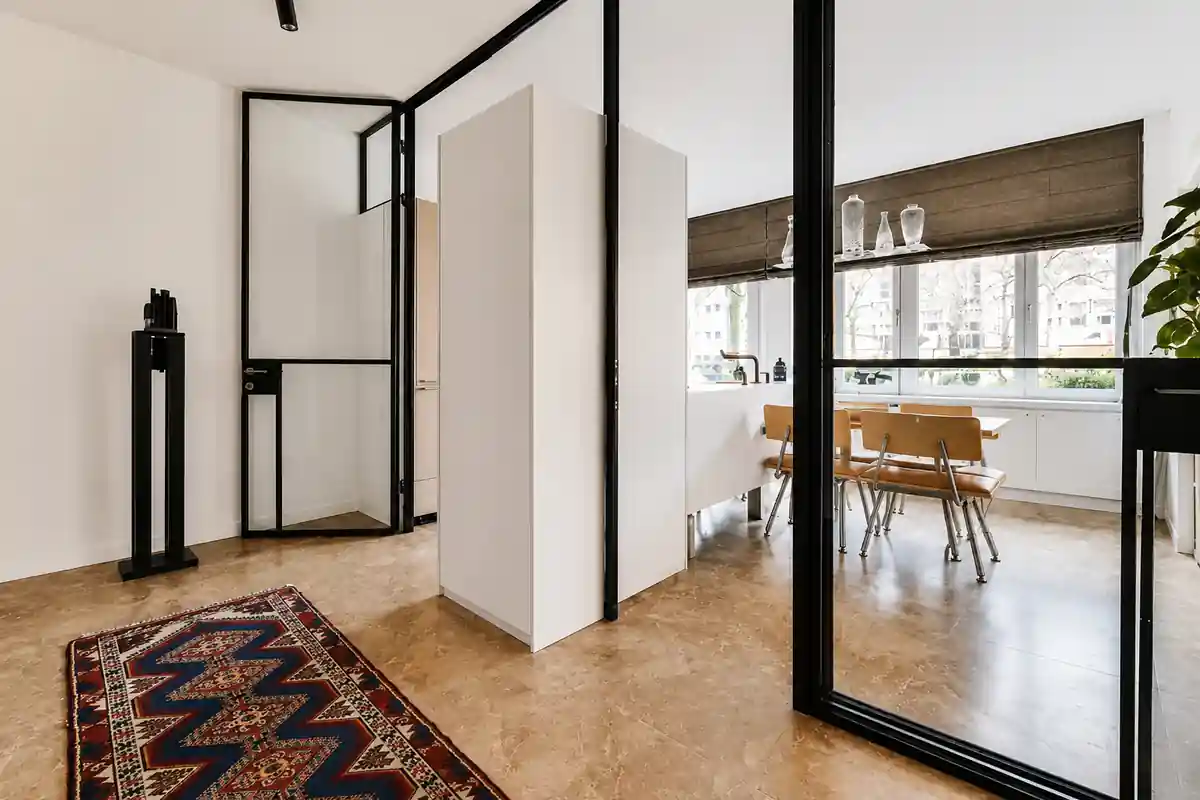
A low storage unit, slim console table, or half-height cabinet can divide two spaces without interrupting sightlines. This type of hall partition design is particularly useful in apartments where every bit of openness makes the room feel larger.
What are Some Simple Ways to Define Spaces Without Blocking Openness?
Let Rugs Do the Work
A rug naturally anchors furniture. Place one beneath the sofa to define the living area and another beneath the dining table to mark the dining zone. Even when the flooring remains continuous, the eye immediately understands that these are two separate spaces.
Arrange Furniture with Purpose
Furniture placement has a surprisingly big impact on how a room feels. Positioning the back of a sofa towards the dining area creates a natural boundary without adding extra furniture. These practical hall-and-dining partition ideas are especially useful when structural changes aren’t an option.
Use Lighting to Create Different Zones
A pendant light or chandelier above the dining table immediately signals a gathering area. In the living room zone, cove lighting, wall sconces, or floor lamps create a softer atmosphere that’s better suited for conversations or relaxation after work.
Add Plants and Decorative Elements
Plants are one of the easiest ways to implement a partition design between living and dining zones without cutting off the line of sight entirely. A tall indoor plant beside the sofa, a row of planters on a console, or hanging greenery near the dining table can gently separate spaces without feeling heavy. Artwork and decorative accessories also help reinforce the identity of each zone.
Wall, Colour, and Flooring Ideas for Visual Separation
When it comes to partition designs between living and dining zones, walls are the most basic solution that work without adding a single piece of furniture.
- An accent wall behind the television instantly establishes the living area, while a different paint finish or wallpaper behind the dining table gives that space its own personality.
- Wooden fluted panels, textured finishes, or decorative mouldings can have the same effect.
- Some homeowners use wooden flooring in the living room and patterned tiles around the dining area.
- Others keep the same flooring throughout but introduce different rugs or ceiling treatments instead.
If you’re planning a living room partition design, combining colour, texture, and lighting often delivers a more natural result than relying on a divider alone.
Best Separation Ideas for Small Living and Dining Rooms
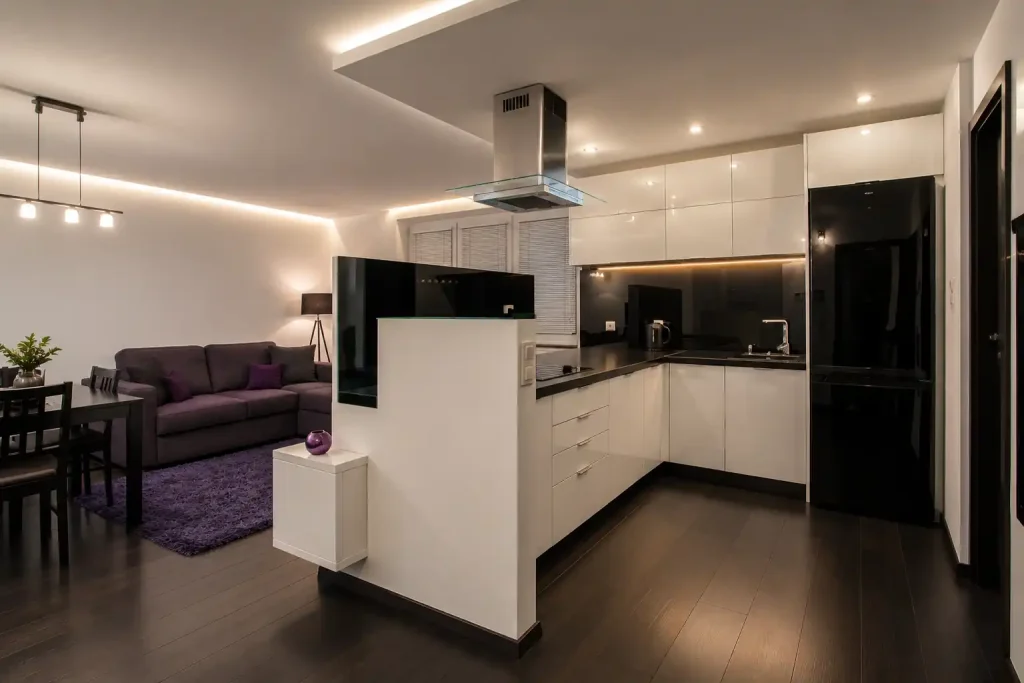
Smaller homes need solutions that don’t steal valuable floor space. Instead of bulky partitions, focus on pieces that define the room while staying visually light. A few ideas that work particularly well include:
- Slim console tables
- Open shelving instead of closed cabinets
- Foldable or sliding partitions
- Mirrors that reflect natural light
- Vertical storage to free up floor space
- Light colour palettes that keep the room feeling open
These ideas are especially useful for homeowners seeking hall-and-dining partition designs for compact apartments.
Create a Seamless Open Layout with Bonito Designs
At Bonito Designs, every layout begins with understanding how the family lives. Through the LifeDesign philosophy, the focus goes beyond aesthetics to create homes that support everyday routines, entertaining, relaxation, and everything in between.
Whether you’re looking for subtle partition designs between living and dining zones in a compact apartment or a customised hall-and-dining partition for a large villa, Bonito Designs brings together design expertise, in-house execution, ISO-certified quality standards, and a seamless process from concept to handover.
Book a consultation with Bonito Designs today to find the right partition designs for your home!
PakarPBN
A Private Blog Network (PBN) is a collection of websites that are controlled by a single individual or organization and used primarily to build backlinks to a “money site” in order to influence its ranking in search engines such as Google. The core idea behind a PBN is based on the importance of backlinks in Google’s ranking algorithm. Since Google views backlinks as signals of authority and trust, some website owners attempt to artificially create these signals through a controlled network of sites.
In a typical PBN setup, the owner acquires expired or aged domains that already have existing authority, backlinks, and history. These domains are rebuilt with new content and hosted separately, often using different IP addresses, hosting providers, themes, and ownership details to make them appear unrelated. Within the content published on these sites, links are strategically placed that point to the main website the owner wants to rank higher. By doing this, the owner attempts to pass link equity (also known as “link juice”) from the PBN sites to the target website.
The purpose of a PBN is to give the impression that the target website is naturally earning links from multiple independent sources. If done effectively, this can temporarily improve keyword rankings, increase organic visibility, and drive more traffic from search results.